Microbes at Work: Building a Smarter MEOR Monitoring Program
How molecular biological tools connect microbial mechanisms with reservoir response and operating decisions
Microbial enhanced oil recovery is not simply about finding microorganisms in a reservoir. A successful MEOR program must determine whether the right organisms and functional genes are present, whether the microbial community responds to treatment, and whether that response is contributing to the intended reservoir effect without creating unacceptable risks.
Molecular biological tools can provide this evidence without the cultivation bias associated with plate counts and most-probable-number methods. When molecular results are evaluated alongside production, pressure, water chemistry, oil composition, and operating data, they can support more informed MEOR design, monitoring, and optimization.
How Microbial Processes Can Support Oil Mobilization
Biosurfactants
Reduce interfacial tension and alter wettability
Mobilize oil held in pore spaces
Biopolymers + Biomass
Restrict preferential flow pathways
Redirect fluids toward less-swept zones
Biogases
Generate methane, CO2, or hydrogen
Support pressure and oil displacement
Organic Acids
Interact with carbonate minerals
Potentially improve permeability and flow
Biosolvents
Influence phase behavior, wettability, and flow
Facilitate oil mobilization
Where MEOR Fits in the Oil-Recovery Continuum
Primary recovery relies on natural reservoir energy. Secondary recovery introduces water or gas to maintain pressure and displace oil toward production wells. After these approaches become less effective, tertiary or enhanced oil recovery methods are used to target residual reserves. MEOR is one enhanced-recovery approach that uses microorganisms, stimulated indigenous communities, introduced cultures, or microbial products to change reservoir conditions in ways that may improve oil displacement and flow.
The feasibility of any MEOR approach is reservoir-specific. Temperature, salinity, pressure, mineralogy, permeability, oil properties, nutrient availability, and microbial ecology all influence which biological mechanisms are realistic and how those mechanisms should be monitored.
The Principal Microbial Mechanisms Behind MEOR
Biosurfactants
Biosurfactants accumulate at oil-water and oil-rock interfaces. By reducing surface and interfacial tension, altering wettability, and emulsifying oil, these microbial products can help overcome forces that retain oil within reservoir pore spaces. Relevant products include lipopeptides, phospholipids, glycolipids, and polymeric surfactants.
Biopolymers and Biomass
High-permeability fractures and channels can allow injected water to bypass oil-bearing regions. Microbial biopolymers, biomass, and biofilms may selectively reduce permeability in preferential pathways, redirecting later fluid flow toward less-swept portions of the reservoir. Because plugging in the wrong location may be undesirable, treatment placement and surveillance are essential.
Biogases
Fermentation and methanogenesis can generate methane, carbon dioxide, and hydrogen. These gases may contribute to pressure maintenance and oil displacement. Monitoring should also account for competing or undesirable processes, including sulfide generation.
Organic Acids and Biosolvents
Fermentative microorganisms can produce organic acids that may interact with carbonate minerals and increase permeability. Microbially produced solvents can influence oil-water separation, interfacial tension, wettability, and oil flow. Reservoir compatibility, achievable production rates, and delivery strategy determine whether these effects can be meaningful at field scale.
Why Presence Alone Is Not Enough
Confirming that microorganisms are present does not show that the desired process is occurring at a meaningful level. An effective monitoring program should establish a baseline, verify treatment arrival, quantify the biological response, identify community shifts, and watch for processes that could reduce performance or increase risk.
The strongest interpretation comes from agreement among microbial, chemical, engineering, and production data. A change in a target gene is more meaningful when it can be evaluated with treatment timing, produced-water chemistry, pressure behavior, oil production, and operating conditions.

CENSUS® qPCR: Quantify Defined Targets
CENSUS® qPCR measures selected genetic targets directly in DNA extracted from a sample. Because it does not require cultivation, qPCR avoids the enrichment step that can distort the apparent community in culture-dependent methods. It is best suited to quantitative tracking when the MEOR mechanism and associated targets are already defined.
Potential MEOR targets include genes associated with biosurfactant production, methanogenic archaea linked to methane generation, and fermenting bacteria associated with carbon dioxide, hydrogen, organic-acid, or solvent production. Targeted monitoring can also be used to track undesirable functions when they are relevant to the project.
NGS: Characterize Community Structure
Next-generation sequencing broadly characterizes bacterial or archaeal community composition without requiring prior knowledge of which organisms are present. NGS is especially valuable for baseline characterization, troubleshooting, and exploratory investigations. Comparisons among samples can reveal changes by location, time, or treatment condition.
NGS results are generally reported as relative abundance, not absolute cell or gene concentrations. Diversity measures, principal coordinate analysis, and hierarchical clustering can help identify community shifts, clusters, and outliers. qPCR can then quantify selected targets identified as relevant through sequencing.
WGS: Add Higher-Resolution Taxonomy and Functional Context
Whole-genome sequencing, also called shotgun metagenomics, analyzes the collective DNA recovered from a sample. It can characterize bacteria, archaea, fungi, and functional genes in one analysis. WGS results can be organized into taxonomic profiles, functional groups, genes, pathways, tables, and heatmaps.
WGS can identify genetic potential associated with fermentation, methanogenesis, acid production, hydrocarbon transformation, sulfate reduction, denitrification, and other reservoir processes. Detection of a functional gene indicates potential and should not be treated as proof of expression or active metabolism without supporting evidence.
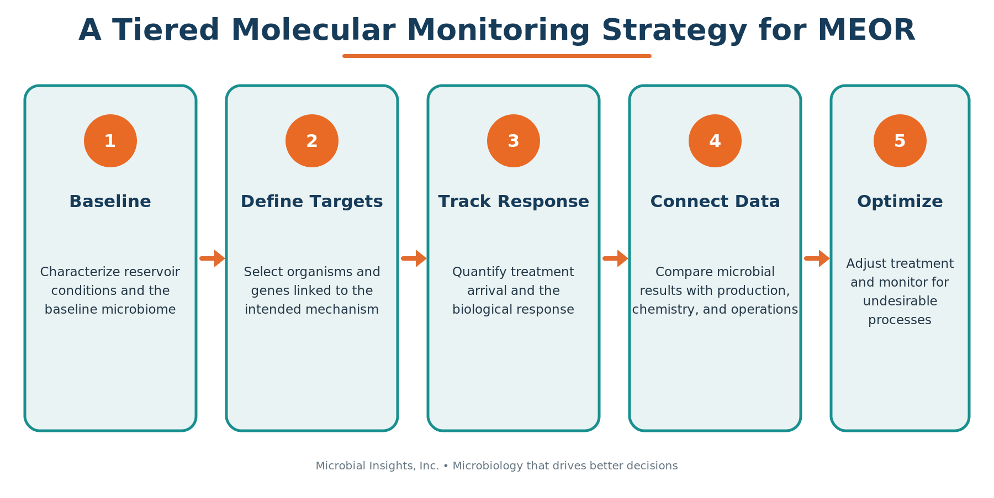
A Five-Phase Framework for Applying Molecular Data
Phase 1: Establish the baseline. Characterize reservoir fluids, water chemistry, temperature, salinity, pressure, oil properties, and baseline microbial composition. Use NGS or WGS when the community is not well defined, then select qPCR targets linked to the proposed MEOR mechanism.
Phase 2: Evaluate compatibility and treatability. Determine whether candidate nutrients, cultures, or microbial products are compatible with reservoir conditions. Confirm that beneficial processes can be stimulated without unacceptable biomass accumulation, misplaced plugging, souring, or unwanted gas production.
Phase 3: Monitor field implementation. Collect pre-injection, injection, and post-injection samples at locations and frequencies that can distinguish treatment arrival, microbial response, and spatial distribution. Pair microbial data with tracer, pressure, production, and geochemical measurements.
Phase 4: Evaluate performance. Trend target genes, community composition, water chemistry, oil production, and operating parameters. Evaluate whether the microbial response precedes or coincides with the intended reservoir effect.
Phase 5: Optimize and continue surveillance. Use the combined evidence to adjust nutrient formulation, dose, injection frequency, shut-in period, or target interval. Continue monitoring for undesirable processes and verify whether operational changes improve performance.
From Microbial Response to Reservoir Decisions
MEOR can involve several complementary mechanisms, but the usefulness of each mechanism depends on reservoir conditions and treatment design. Molecular tools strengthen an MEOR program by directly measuring organisms and genes associated with desired and undesired processes.
CENSUS® qPCR provides quantitative surveillance. NGS adds community-level context. WGS provides higher-resolution taxonomy and direct functional-gene profiles. Integrated with engineering, production, and geochemical information, these tools can provide a stronger basis for MEOR design, performance evaluation, and optimization.