Comprehensive Microbial Analysis for Chlorinated Solvent Remediation

QuantArray®-Chlor analysis quantifies twenty-nine key microorganisms (e.g., Dehalococcoides, Dehalobacter, Dehalogenimonas, etc.) and functional genes (e.g., vinyl chloride reductase, methane monooxygenase, etc.) to assess the potential for reductive dechlorination and aerobic cometabolism of chlorinated solvents as well as competing biological processes.

QuantArray®-Chlor results simultaneously yet economically illuminate degradation pathways for a broad spectrum of common chlorinated compounds, including chlorinated ethenes, chlorinated ethanes, chlorinated methanes, chlorinated propanes, chlorinated phenols, chlorinated benzenes, and polychlorinated biphenyls (PCBs). When combined with chemical and geochemical groundwater monitoring programs, QuantArray® provides actionable data that can be used to better understand the subsurface microbial community and increase confidence in site management decisions.

MI QuantArray ER logo

QUANTARRAY®-CHLOR ADVANTAGES:

Icon-Accurate

ACCURATE

Direct analysis of sample DNA removes the need to grow the bacteria, thus eliminating biases associated with traditional approaches (e.g., plate counts and MPNs).

icon-Quantitative

QUANTITATIVE

Absolute quantification of the concentrations of specific microorganisms and functional genes encoding enzymes responsible for contaminant biodegradation gives site managers a direct line of evidence to evaluate remediation options and monitor remedy performance. Results reported as cells/mL, cells/g, etc.

icon-CostEffective

COST EFFECTIVE

In a single analysis, quantify microbes responsible for reductive dechlorination, aerobic cometabolism, and competing processes. QuantArray®-Chlor is as accurate as CENSUS®qPCR, but is more comprehensive and cost-effective.

Informative Icon

INFORMATIVE

Is that a low, medium or high concentration of contaminant degraders? With the MI Database, clients can retrieve percentile rankings of their QuantArray® results to answer that question based on the tens of thousands of samples MI has received from sites around the world.

Icon-Sensitive

SENSITIVE

The Method Detection Limit (MDL) is 10 cells/sample and the Practical Quantification Limit (PQL) is 250 cells/sample. Low detection limits are particularly important when evaluating whether bioaugmentation is needed or an unnecessary expense.

icon-Specific

SPECIFIC

Target specific bacterial groups (e.g., Dehalococcoides, Dehalobacter, Dehalogenimonas) and functional genes (e.g., vinyl chloride reductases) responsible for contaminant biodegradation.

icon-Flexible

FLEXIBLE

Analysis can be performed on almost any type of sample (water, soil, sediments, Bio-Traps®, and others).

HOW TO USE QUANTARRAY®-CHLOR:

Along with contaminant concentrations and geochemical parameters, the concentrations of specific microorganisms and functional genes responsible for contaminant biodegradation are a key component of remedy selection and performance monitoring at sites impacted by chlorinated solvents.

Use QuantArray® to help answer…

  • How feasible is MNA? Is enhanced bioremediation needed? Is bioaugmentation needed?
    • What are the concentrations of contaminant degraders under existing conditions?
    • Are degrader concentrations greater in impacted wells than background wells?
    • Based on the MI Database, are concentrations of contaminant degraders low, medium, or high in the plume?

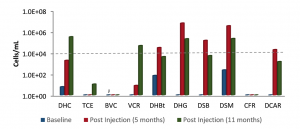
Graph that provides examples for QuantArray methods


  • Is enhanced bioremediation effective?
    • Did concentrations of contaminant degraders and functional genes increase in response to treatment?
    • Are additional types of degraders and functional genes now detected that were previously below detection limits?

GENE TARGETS INCLUDED IN A SINGLE QUANTARRAY®-CHLOR qPCR ANALYSIS

TARGETCODERELEVANCE / DATA INTERPRETATION
DehalococcoidesDHCDehalococcoides (DHC) is the only known bacterial group capable of complete reductive dechlorination of PCE to ethene. Lu et al. have proposed a Dehalococcoides concentration of 1 x 10^4 cells/mL as a screening criterion to identify sites where biological reductive dechlorination is predicted to proceed at “generally useful” rates.
Functional GenesTCE, BVC, VCRThree functional genes encoding reductive dehalogenases for TCE, DCE and VC to evaluate the potential for complete reductive dechlorination to ethene.
DehalobacterDHBtCapable of reductive dechlorination of PCE and TCE to cis-DCE but also utilize chlorinated ethanes, common co-contaminants at TCE sites.
Dehalobacter DCMDCMDichloromethane can support growth of a distinct group of Dehalobacter strains via fermentation. The Dehalobacter DCM assays targets the 16S rRNA gene of these strains.
DehalogenimonasDHGDehalogenimonas spp. are best known for dichloroelimination of chlorinated alkanes. However, the Dehalogenimonas WBC-2 culture and Dehalogenimonas strain GP have been shown to be capable of reductive dechlorination of trans-1,2-dichloroethene and vinyl chloride, respectively.
cerA ReductaseCERTargets the vinyl chloride reductase gene from Dehalogenimonas strain GP, the only known organism other than Dehalococcoides capable of vinyl chloride reduction.
trans-1,2-DCE ReductaseTDRTargets the gene for trans-1,2-dichloroethene reductive dehalogenase (TdrA) from Dehalogenimonas sp. WBC-2 involved in the dechlorination of trans-DCE to vinyl chloride.
DesulfitobacteriumDSBReductive dechlorination of PCE and TCE to cis-DCE.
Dehalobium chlorocoerciaDECODehalobium chlorocoercia DF-1 has been shown to be capable of reductive dechlorination of HCB, PeCB and 1,2,3,5-TeCB.
Desulfuromonas spp.DSMReductive dechlorination of PCE and TCE to cis-DCE using acetate as an electron donor.
PCE-1 ReductasePCE-1Targets the pceA reductase genes for the sequential reductive dechlorination of PCE to cis-DCE by Sulfurospirillum species. In mixed cultures, partial dechlorinators like Sulfurospirillum and Geobacter may be responsible for the majority of reductive dechlorination of PCE to cis-DCE with Dehalococcoides functioning as cis-DCE and vinyl chloride reducing specialists.
PCE-2 ReductasePCE-2Targets the pceA reductase genes responsible for the sequential reductive dechlorination of PCE to cis-DCE by Geobacter species.
Chloroform ReductaseCFRTargets the cfrA gene of Dehalobacter spp. that encodes a reductase enzyme responsible for dechlorination of chloroform and 1,1,1-TCA.
1,1 DCA ReductaseDCATargets the 1,1-dichloroethane reductive dehalogenase gene found in some strains of Dehalobacter.
1,2 DCA ReductaseDCARTargets the 1,2-dichloroethane reductive dehalogenase gene from members of Desulfitobacterium and Dehalobacter , which dechlorinate 1,2-DCA to ethene.
Soluble Methane MonooxygenaseSMMOTargets the gene encoding soluble methane monooxygenases which can co-oxidize a broad range of chlorinated compounds including TCE, cis-DCE, and vinyl chloride. Furthermore, soluble methane monooxygenases are generally believed to support greater rates of aerobic cometabolism.
Toluene DioxygenaseTODToluene dioxygenase has relatively relaxed substrate specificity and mediates the incorporation of both atoms of oxygen into the aromatic ring of benzene and substituted benzenes (toluene and chlorobenzene). Comparison of TOD levels in background and source zone samples from a CB impacted site suggested that CBs promoted growth of TOD containing bacteria
Phenol HydroxylasePHEPhenol hydroxylase catalyzes the continued oxidation and in some cases, the initial oxidation of a variety of monoaromatic compounds. In an independent study, significant increases in numbers of bacteria containing PHE genes corresponded to increases in biodegradation of DCB isomers.
Trichlorobenzene DioxygenaseTCBOThe TCBO assay targets the genes encoding aromatic dioxygenases responsible for initiating aerobic biodegradation of a number of chlorinated benzenes including chlorobenzene, 1,2-dichlorobenzene, 1,2,4-trichlorobenzene, and 1,2,4,5-tetrachlorobenzene.
Toluene Monooxygenase 2RDEGAlso targets the ring-hydroxylating toluene monooxygenase genes (toluene-2-monooxygenase). As with RMO, toluene-2-monooxygenases are capable of cometabolism of TCE.
Toluene MonooxygenaseRMOTargets a group of genes encoding ring-hydroxylating toluene monooxygenase (toluene-3- and toluene-4-monooxygenases) capable of co-oxidation of TCE. In some laboratory studies, TCE or a degradation product has been shown to induce expression of toluene monooxygenases, raising the possibility of TCE cometabolism with alternative (non-aromatic) growth substrates.
Ethene MonooxygenaseETNEnumerates functional genes (etnC and etnE) involved in ethene utilization and vinyl chloride (co)metabolism. The ethene monooxygenase (EtnABCD) converts ethene and vinyl chloride to their respective epoxyalkanes, while epoxyalkane:CoM transferase (EtnE) mediates conjugation and breaking of the epoxide.
Dichloromethane DehalogenaseDCMATargets the dcmA gene responsible for aerobic biodegradation of dichloromethane by methylotrophs.
Total EubacteriaEBACIndex of total bacterial biomass
Sulfate Reducing BacteriaAPSQuantification of sulfate reducing bacteria provides an additional line of evidence when evaluating redox conditions and terminal electron accepting processes.
MethanogensMGNMethanogens utilize hydrogen and can compete with halorespiring bacteria for available electron donor.

FREQUENTLY ASKED QUESTIONS

How soon can I expect to receive the QuantArray®-Chlor results?

The turnaround time to receive a QuantArray®-Chlor report is 7-14 calendar days.

What does the concentration of Dehalococcoides mean?

Lu et al. (2006) proposes using a Dehalococcoides concentration of 1×10⁴cells/mL as a screening criterion to identify sites where reductive dechlorination of chlorinated ethenes is predicted to proceed at “generally useful” rates.

The best way to understand if a concentration is high, medium, or low, is to access the Microbial Insights database and review the percentile rankings for each organism related to that particular sample matrix.  With CENSUS® qPCR and QuantArray® results for more than 250,000 field samples from sites around the world, this database is the largest collection of field concentrations of key microorganisms and functional genes.

What sample matrix should I submit for QuantArray®-Chlor testing?

QuantArray®-Chlor can be performed on nearly any sample type, including water, sediment, and Bio-Trap®samplers. Download the Tech Bulletin “Choosing a Sample Matrix to Assess In Situ Reductive Dechlorination” to learn more about the different types of samples and important considerations for sampling and interpretation.

How is QuantArray® different from CENSUS® qPCR and multiplex qPCR?

In many respects, QuantArray® is the same as conventional qPCR, so you can expect the same level of accuracy and precision.  Other methods like multiplex qPCR have been described that achieve some level of parallel quantification.  However, there is a fundamental difference between the QuantArray® and multiplex qPCR.  For multiplex qPCR, multiple primer sets are added to a reaction mixture to quantify multiple gene targets whereas QuantArray® employs discrete through-holes for individual qPCR reactions ensuring that reaction kinetics are not compromised. Download our “CENSUS® versus QuantArray®” white paper for further information.

Microbial Insights' Technical Exchange Logo

RESOURCES FOR REMEDIATING CHLORINATED VOCS

CASE STUDIES FROM CHLORINATED SOLVENT SITES

NGS and QuantArray®-Chlor: Characterizing Microbial Communities and Assessing Biodegradation Potential

• A pilot study was conducted at a site where electron donor was injected into groundwater impacted by a mixture of chlorinated solvents.

• QuantArray®-Chlor and NGS provided complimentary evidence of both biotic and abiotic reductive dechlorination in response to the injection of the electron donor giving the client confidence in this remediation strategy expanding electron donor injection to the entire site.

QuantArray®-Chlor: Actionable Data for Remedy Selection

• Site managers were considering monitored natural attenuation (MNA), biostimulation, and bioaugmentation as remediation strategies at a site impacted by a complex mixture of chlorinated hydrocarbons including PCE, TCE, 1,1,2-TCA, 1,2-DCA, cis-DCE, and VC along with high concentrations of sulfate.

• QuantArray®-Chlor analysis provided actionable data for remedy selection allowing timely decisions and significant cost savings in site management.

QuantArray®-Chlor: Actionable Data for Performance Monitoring

• QuantArray®-Chlor analysis allowed site managers to have a comprehensive understanding of all relevant microbial processes at the site over time which allowed timely decisions and significant cost savings in site management.

QUESTIONS?

READY TO ORDER?