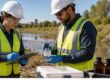
Microbial Insights is proud to collaborate with federal regulatory and grant agencies, bringing our scientific expertise and in-house capabilities to support government programs and strengthen regulatory compliance. We regularly provide training for federal and state agencies on how molecular biological tools (MBTs) can serve as powerful lines of evidence in routine site assessments including Superfund sites, Brownfield projects, and more.
Interested in scheduling a training session for your team? We’d be happy to help. Connect with us at info@microbe.com.
Our impact is further amplified through competitive grant funding. Today, we’re spotlighting two National Science Foundation (NSF)–funded projects where Microbial Insights’ deep experience with MBTs helped advance initiatives that protect public health and the environment.
Microbial Source Tracking
Fecal contamination in waterways and along our beaches isn’t just an environmental concern, it poses real risks to public health and can trigger costly consequences such as beach closures and limits on shellfish harvesting. Traditional culture-based methods can detect fecal indicator bacteria, but they fall short in one critical area: identifying which animal the contamination came from.
To address this gap, Microbial Insights received National Science Foundation (NSF) funding beginning in 2006 to develop a suite of qPCR microbial source tracking (MST) assays. These assays were designed to pinpoint likely contamination sources—including human, dog, ruminant, seagull, and Canada goose—providing a powerful tool for targeted decision-making. Each assay underwent rigorous testing and validation to ensure reliability, and their strength has stood the test of time. Today, stakeholders across the country continue to rely on these MST tools to guide effective corrective actions and protect the quality of our nation’s waters.

Beach Survey Case Study
The MST qPCR assays offer a powerful way to pinpoint the true sources of fecal pollution—whether the contamination originates from sewer leaks, failing septic systems, agricultural runoff, stormwater drainage, wildlife, or even recreational activities.
In one survey of frequently impaired beaches, MST analyses were used to evaluate environmental samples and uncover the real drivers behind repeated water quality issues. The results told an important story: at two beaches, both human and seagull sources were contributing to poor water quality. At two others, the main contributors were human and dog inputs. These insights did more than identify the problem. They pointed directly to practical, achievable solutions. Simple actions such as increasing public education, improving trash management to deter seagulls, and enforcing “stoop and scoop” rules for dog owners could significantly reduce contamination and boost water quality at these sites.
By revealing where fecal pollution truly comes from, MST tools empower communities to take targeted action—and make meaningful improvements to the waterways people depend on.

East Palestine, OH Train Derailment
In early 2023, a freight train derailment in East Palestine, Ohio, released more than 100,000 gallons of vinyl chloride and butyl acrylate—chemicals that pose serious risks to both human health and the environment. In response, Microbial Insights partnered with the University of Tennessee’s Loeffler Lab to launch an NSF-funded Rapid Response Research (RAPID) project aimed at understanding whether naturally occurring microbes could help break down these hazardous compounds.
To move quickly and generate high quality data, the team collected environmental samples and used innovative Bio-Extract™ kits to perform DNA extractions directly in the field. Back in the lab, they applied trusted MBTs including QuantArray®-Chlor and next generation sequencing to assess the microbial community’s natural attenuation capacity for biodegradation. They also set up microcosm studies to observe how these chemicals break down under controlled conditions.
The foundational data generated through this project provided options for long term recovery strategies and helped establish site specific monitoring protocols, bringing science to the forefront of community and environmental protection after a major chemical release.
Team with Microbial Insights
Microbial Insights is proud to support ongoing collaborations among government agencies, the private sector, and academic partners. This month, we’re excited to sponsor, and participate in, the Interstate Technology & Regulatory Council (ITRC) Annual Meeting, an important gathering focused on advancing innovative, science based environmental solutions. If you’ll be attending, we’d love to connect. Please stop by and say hello!
Interested in exploring a collaboration or scheduling targeted training for your team? We’re here to help. Reach out to Microbial Insights at 865-573-8188 or [email protected].